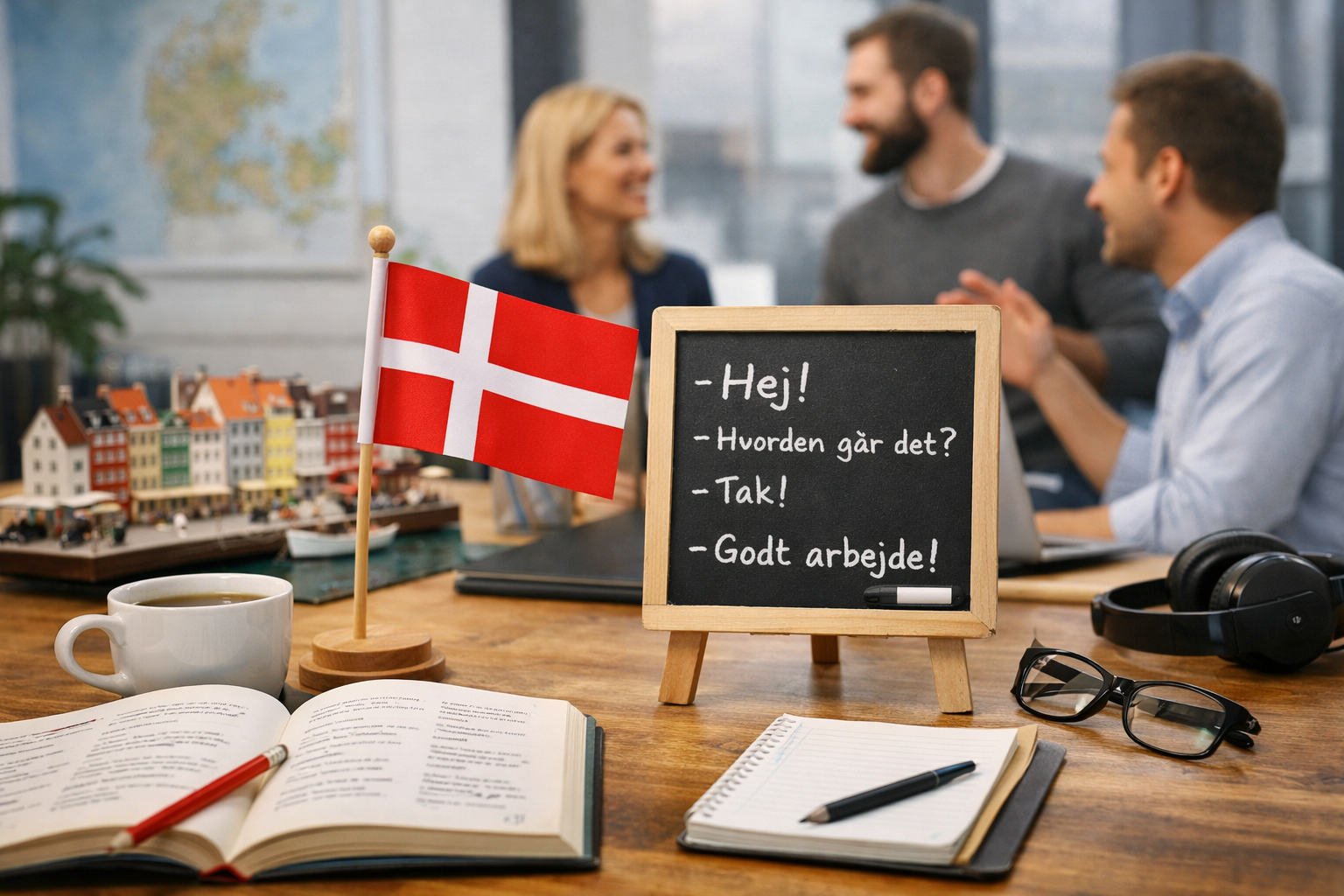
Why Bother With Danish?
Almost every Dane speaks excellent English, so you can technically work in Denmark without learning a word of Danish. But here's the thing — Danes are deeply impressed and appreciative when foreign workers make an effort to learn their language. It builds stronger relationships and can accelerate your career.
Essential Workplace Phrases
- Godmorgen (go-morn) — Good morning
- Tak (tahk) — Thank you
- Undskyld (oon-skool) — Excuse me / Sorry
- Jeg forstår ikke (yai for-store ik-ke) — I don't understand
- Kan du gentage? (kan doo gen-tay) — Can you repeat?
- Hvor er...? (vor air) — Where is...?
- Jeg har brug for hjælp (yai har broo for yelp) — I need help
- Pas på! (pas po) — Watch out!
- Pause (pow-se) — Break
- Fyraften (fyr-af-ten) — End of work day
Numbers for the Workplace
- En, to, tre, fire, fem (1-5)
- Seks, syv, otte, ni, ti (6-10)
- Klokken = o'clock (Klokken seks = 6 o'clock)
- Daghold = day shift, Aftenhold = evening shift, Nathold = night shift
Danish Pronunciation Tips
Danish pronunciation is notoriously difficult — even Swedes and Norwegians joke about it. Key tips:
- The "d" is often silent or softened (like "th" in English)
- "Rød grød med fløde" (red berry pudding with cream) is the famous tongue-twister that tests your Danish
- Don't worry about perfection — Danes appreciate any attempt
- Listen to Danish podcasts or radio to tune your ear
Free Learning Resources
- Duolingo — Free Danish course, good for absolute beginners
- Babbel — More structured Danish lessons (subscription)
- Danish classes through your kommune — Most municipalities offer free Danish lessons for foreign workers
- DR (Danish Radio) — Free streaming at dr.dk. Watch "Matador" or "Borgen" with English subtitles
The Social Benefit
Learning Danish opens social doors. Danish colleagues will invite you for Friday drinks (fredagsbar), include you in conversations, and share cultural insights. This social integration is key to a happy life in Denmark.
Find your Danish opportunity and start learning on the way. Held og lykke! (Good luck!)
What this guide covers
This guide focuses on Learning Basic Danish for Work: Phrases That Will Impress Your Colleagues. Danish pronunciation is famously tricky, but learning even a few phrases earns huge respect from Danish colleagues. Here are the essentials for the workplace. The sections below translate that framing into concrete steps, common mistakes from workers who walked this path before you, and a checklist you can run through in one sitting before deciding on next moves.
Why this matters now
Moving to Europe is logistically simple in theory: passport, visa, plane ticket. In practice the first 30 days decide whether you settle in cleanly or burn savings on avoidable mistakes. Below is a calmer, more concrete map.
The Denmark context
Denmark sits at the centre of this story for several practical reasons. Salaries in our partnership network here run €3,100-4,300/month, with visa processing typically 6-10 weeks once your file is complete. Major employers cluster around Copenhagen, Aarhus, Aalborg, and the dominant industries hiring international workers are food processing, wind energy, pharmaceutical, warehouse. Put simply: highest blue-collar wages in Europe with a 37-hour standard work week.
That context shapes every subsequent decision — which city to target first, which recruiter has real placement relationships, which sector renews contracts year over year, and which residency-step paperwork is realistic to complete in the first 12 months.
Across our partnership network in Denmark, the common pattern for first-time international workers is a 12-month entry contract followed by a renewal at year 1, then a sector or employer optimisation move at year 2-3, and a permanent-residency or citizenship step at year 5 or beyond. Workers who treat the first contract as the start of a 5-year arc consistently outperform those who treat it as a one-shot opportunity.
Step-by-step breakdown
- Step 1. Two weeks before departure: confirm passport validity (18+ months recommended), print all documents in duplicate, pack a 7-day clothing kit appropriate to the destination season.
- Step 2. Day of arrival: keep cash to cover 7 days, transit pass, charged phone with destination SIM ready, and the employer or recruiter's emergency contact saved.
- Step 3. Days 1-3: register at the local residency office, open a bank account (most employers require an IBAN before first paycheck), set up healthcare registration where applicable.
- Step 4. Days 4-14: apply for tax number, local mobile contract, residency card. Forward your home-country mail to a trusted contact who can scan and send.
- Step 5. Days 15-30: build local reference points — a doctor, a grocery store, a transport route, a community centre. The first 30 days set the next 12 months' rhythm.
Common pitfalls and how to avoid them
- Underestimating winter clothing costs in Northern Europe. Workers from Pakistan, Bangladesh, India and parts of Africa frequently arrive in October without thermals or insulated boots and lose €200-400 in the first cold week.
- Skipping mandatory healthcare registration in the first month assuming the employer handles it. Some do; many don't until you ask.
- Bringing too much cash. Most EU countries require declaration above €10,000 and getting a local IBAN within the first 14 days makes everything from rent to phone contracts to employer reimbursements smoother.
- Booking a one-way ticket without confirming the residency-registration deadline (Anmeldung in Germany, soggiorno in Italy, registracja in Poland). These deadlines start ticking on arrival day, not on contract day.
Frequently asked questions
Will my employer pick me up at the airport?
Many partner employers do — especially for first-time international workers — and CHI Recruiting confirms this in advance. If not, the recruiter provides written instructions for the airport-to-accommodation transfer (train, taxi, prepaid bus).
How quickly can I bring my family?
Family reunification typically requires 12-24 months of continuous employment plus proof of housing capacity. Some countries (Denmark, Germany) move faster than others (Italy, France) on processing.
Do I need to bring my own bedding/cookware?
Most employer-provided accommodation comes furnished with bed, bedding, basic kitchen, washing machine. Personal items (toiletries, prayer mat, small electronics with EU plug adapter) are worth packing.
How much money should I bring on day one?
Cash equivalent to €500-800 for the first 14 days (transit, food, basic SIM). More than €10,000 must be declared at EU borders. Most expenses can be paid by card once your local bank account opens (typically within the first 7 days).
What about driving — can I use my home-country license?
In the EU, most non-EU licenses are valid for 6 months from arrival, after which you need an EU license. Many workers do not need a car (employer-provided shuttle or public transport handle the commute), but plan ahead if your role requires driving.
Action checklist
- Open local bank account in week 1
- Bring €500-800 in cash for first 14 days
- Schedule residency registration within 14 days of arrival
- Confirm passport 18+ months valid
- Pack a 7-day kit appropriate to destination weather
Resources to bookmark
- Official immigration portals — every EU country publishes its work-permit guidance in English. Bookmark the official portal for your destination (e.g. diplo.de for Germany, nyidanmark.dk for Denmark, gov.pl for Poland) and check it once a month for rule changes.
- Sector wage councils — Germany's Mindestlohnkommission, Denmark's sector unions, Poland's national wage announcements. These move 6 months ahead of what employers actually pay.
- Eurostat labour statistics — quarterly releases on employment, vacancy rates, and average wages by sector. Useful for sense-checking employer claims.
- CHI Recruiting blog — country-by-country guides, sector-specific salary research, and updates on visa quota changes from your home country.
- Worker community groups — Telegram, WhatsApp and Facebook groups by country and source-country. Look for those moderated by long-term residents, not recruitment agencies posing as community.
Glossary of terms you will see
- Type D visa — long-stay national visa used by most EU countries to admit non-EU workers. Tied to a specific employer and job.
- Single permit — combined work and residence permit issued in countries like Czech Republic, Slovakia, Croatia. Simplifies the paper chain.
- Blue Card — EU-wide highly-skilled worker permit. Mostly relevant for university-educated roles, not blue-collar.
- Anmeldung / soggiorno / TRP — local residency registration that must happen within a fixed window (often 14 days) after arrival.
- IBAN — international bank account number; required by most employers before first paycheck.
- Mindestlohn / minimum wage — country-set floor that defines the lower bound on legal pay. Updated yearly.
- Apostille — international certification that authenticates documents (education, police, marriage). Most EU countries now accept it instead of the older consular legalisation chain.
Related guides
- Understanding European Rental Markets: A Country-by-Country Guide for Foreign Workers
- Grocery Shopping in Europe on a Budget: A Guide for South Asian Workers
- Understanding European Tipping Culture: A Guide for Foreign Workers
- Public Transport Guide for Workers in Europe: Getting Around Without a Car
Looking for a specific role aligned with this guide? Browse open positions at CHI Recruiting — every job page lists the country-specific salary, contract length, and onboarding details so you can match this guide to live opportunities. Reference: BLOG-LEARNING-BASIC-DANISH-WO.