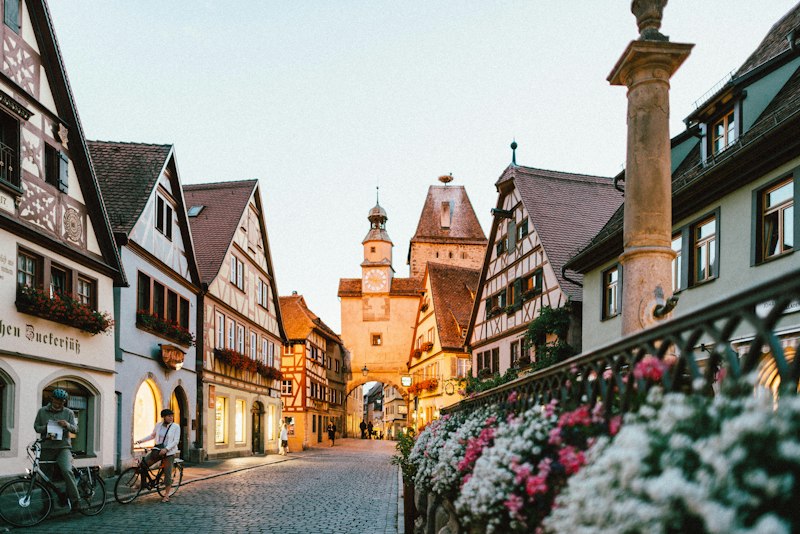
Europe Is Yours to Explore
One of the greatest benefits of working in Europe is the ability to travel to different countries on your days off. With budget airlines, fast trains, and excellent bus networks, you can visit famous cities, beaches, and mountains for surprisingly little money. Your EU work permit allows visa-free travel across all 27 EU/Schengen countries.
Budget Travel Tips
- FlixBus — The cheapest way to travel between European cities. Tickets from EUR 5-15 for journeys of 3-6 hours.
- Ryanair and Wizz Air — Budget airlines with flights from EUR 10-30 if booked 2-3 weeks ahead.
- Deutsche Bahn Supersparpreis — German train tickets from EUR 17.90 when booked early.
- Hostels — Clean and social accommodation from EUR 15-25/night. Book on Hostelworld or Booking.com.
- Free walking tours — Available in every major European city. Tip-based, so you decide what to pay.
Trip Ideas from Germany
- Prague, Czech Republic — 4-5 hours by bus from most German cities. Beautiful old town, affordable food and beer. Weekend budget: EUR 80-120.
- Amsterdam, Netherlands — 6 hours by bus or 4 hours by train from western Germany. Canals, museums, and cycling culture. Budget: EUR 100-150.
- Salzburg, Austria — 2 hours from Munich. Stunning Alpine scenery. Budget: EUR 80-120.
Trip Ideas from Poland
- Krakow to Zakopane — 2 hours by bus to Poland's mountain resort town. Hiking in summer, skiing in winter. Budget: EUR 40-60.
- Warsaw to Gdansk — 5 hours by train to the Baltic coast. Beautiful beaches and historic old town. Budget: EUR 50-80.
- Wroclaw to Berlin — 4 hours by bus. Germany's vibrant capital with free museums on certain days. Budget: EUR 70-100.
Trip Ideas from Denmark
- Copenhagen to Malmo, Sweden — 30 minutes by train across the famous Oresund Bridge. Budget: EUR 30-50 for a day trip.
- Hamburg, Germany — 4.5 hours by train. Famous port city with great nightlife. Budget: EUR 80-120.
Making the Most of Your Time
- Plan during the week — Research and book transport and accommodation on quiet evenings after work.
- Travel with colleagues — Splitting accommodation costs makes trips more affordable and more fun.
- Take photos for family — Sharing your European adventures with family back home is a great way to stay connected.
- Try local food — Each country has unique dishes. Eating local is often cheaper than tourist restaurants.
Working in Europe is not just about earning — it is about experiencing a continent rich in history, culture, and beauty. Start your European adventure with a position through CHI Recruiting.
What this guide covers
This guide focuses on Weekend Trip Ideas for Workers in Europe: Explore on Your Days Off. Europe is compact and well-connected. Discover affordable weekend trips from your base in Germany, Poland, Denmark, or the Czech Republic. The sections below translate that framing into concrete steps, common mistakes from workers who walked this path before you, and a checklist you can run through in one sitting before deciding on next moves.
Why this matters now
Working abroad changes more than your salary. It changes how recruiters in your home country read your CV, how your savings rate compounds, and which doors open for permanent residency or family sponsorship later. The sections below treat it as a multi-year strategic decision, not a single job.
The Europe-wide context
Across our placement network — currently 13 European countries spanning from Denmark in the north to Albania and Montenegro on the Adriatic — the underlying pattern for international blue-collar workers is consistent: 12-month entry contracts, accommodation typically included, salaries from €1,500 to €4,300/month depending on country and sector, with renewal and residency milestones aligned to a 5-year arc.
What varies most across countries is processing speed (Poland and Serbia among the fastest at 4-6 weeks; Italy and Vietnam-origin applications among the slowest at 12-16), cost of living (Bulgaria and Albania among the lowest; Denmark and France among the highest), and the path to permanent residency (clear and well-supported in Germany, Denmark, Czech Republic; less defined in non-EU destinations like Turkey).
Step-by-step breakdown
- Step 1. Step 1: Define what you are optimising for — savings, residency path, family reunification, sector experience, or some combination. The country selection follows from this.
- Step 2. Step 2: Shortlist 2-3 destinations using the comparison matrix (gross salary, cost of living, visa processing time, residency timeline).
- Step 3. Step 3: Match yourself to a sector with stable year-round demand in the destination. Sector matters more than employer at this stage.
- Step 4. Step 4: Use a recruiter who is paid by the employer side or transparently disclosed by you — never one who charges 6-figure rupees and is opaque about visa fees.
- Step 5. Step 5: Once a contract is offered, allow 6-12 weeks for visa processing, plan the relocation finances (3 months of European living costs in reserve), and prepare the document folder.
- Step 6. Step 6: Year 1 — maintain employment continuity, register every step (tax, residency, healthcare). Year 2 — review and either renew or pivot.
Common pitfalls and how to avoid them
- Signing a 1-year contract in a sector that doesn't have stable demand year-round. Construction in Croatia, agriculture in Italy, and tourism everywhere all dip in winter months — choose one that hires year-round if savings are the goal.
- Assuming family reunification is a year-1 option. Most EU states require 12-24 months of stable employment and proof of housing capacity before approving spouse or child visas.
- Ignoring the route to permanent residency at year 5. Some countries (Germany, Denmark) have well-defined paths; others (Turkey, Serbia non-EU) do not lead to EU permanent residency at all even after a decade.
- Picking the country with the highest gross salary without modelling cost of living, accommodation costs, and tax. Denmark gross looks 2x Poland gross, but net-after-rent often differs less than expected.
Frequently asked questions
Can my children attend free school in Europe?
Yes — once family reunification is processed (typically year 2), children attend public school free in most EU countries. Schools provide language support classes for new arrivals at no cost.
Is there a path to citizenship?
After permanent residency (typically year 5), most EU member states allow citizenship application after another 3-5 years. Germany and Denmark are among the more accessible; Italy and France have longer waits.
What if I don't speak the local language?
All major employers we work with provide on-site language coaching, with English as the operating language for the first 6-12 months. Learning the local language pays back quickly in residency interviews, healthcare, tenancy and promotions.
Which European country pays best after housing costs?
For blue-collar workers, Denmark and Germany lead on net-after-housing because employer-provided accommodation is included; gross-salary winners (Switzerland, Norway) often do not include housing and have very high cost of living. Czech Republic and Poland win on savings rate as a percentage of net.
How long until I can apply for permanent residency?
5 years of continuous legal employment in most EU member states (Germany, Denmark, France, Italy). Some countries offer faster routes for specific shortage occupations. Non-EU countries (Turkey, Serbia, Montenegro) do not lead to EU permanent residency.
Action checklist
- Plan 3 months of European living costs as reserve
- Match self to year-round-demand sector
- Choose recruiter with transparent fee structure
- Define optimisation target (savings vs residency vs family)
- Compare 2-3 destinations on net-after-housing salary
Resources to bookmark
- Official immigration portals — every EU country publishes its work-permit guidance in English. Bookmark the official portal for your destination (e.g. diplo.de for Germany, nyidanmark.dk for Denmark, gov.pl for Poland) and check it once a month for rule changes.
- Sector wage councils — Germany's Mindestlohnkommission, Denmark's sector unions, Poland's national wage announcements. These move 6 months ahead of what employers actually pay.
- Eurostat labour statistics — quarterly releases on employment, vacancy rates, and average wages by sector. Useful for sense-checking employer claims.
- CHI Recruiting blog — country-by-country guides, sector-specific salary research, and updates on visa quota changes from your home country.
- Worker community groups — Telegram, WhatsApp and Facebook groups by country and source-country. Look for those moderated by long-term residents, not recruitment agencies posing as community.
Glossary of terms you will see
- Type D visa — long-stay national visa used by most EU countries to admit non-EU workers. Tied to a specific employer and job.
- Single permit — combined work and residence permit issued in countries like Czech Republic, Slovakia, Croatia. Simplifies the paper chain.
- Blue Card — EU-wide highly-skilled worker permit. Mostly relevant for university-educated roles, not blue-collar.
- Anmeldung / soggiorno / TRP — local residency registration that must happen within a fixed window (often 14 days) after arrival.
- IBAN — international bank account number; required by most employers before first paycheck.
- Mindestlohn / minimum wage — country-set floor that defines the lower bound on legal pay. Updated yearly.
- Apostille — international certification that authenticates documents (education, police, marriage). Most EU countries now accept it instead of the older consular legalisation chain.
Related guides
- Italy Work Visa: How to Get Your Nulla Osta and Permesso di Soggiorno
- Family Reunification in Europe: How to Bring Your Family After You Settle
- Denmark Work Permit Guide: How to Secure Your Visa
- Croatia Work Permit Guide: Your Gateway to the EU Labour Market
Looking for a specific role aligned with this guide? Browse open positions at CHI Recruiting — every job page lists the country-specific salary, contract length, and onboarding details so you can match this guide to live opportunities. Reference: BLOG-WEEKEND-TRIP-IDEAS-WORKE.